What are Geotextiles?
Laminar, flexible, and porous textiles primarily made from polypropylene or polyester, consisting of polymeric fibers joined together through weaving, needling, or thermal bonding. These textiles are designed with specific characteristics of strength and porosity to be used in solving various geotechnical problems related to filtration, drainage, protection, stabilization, reinforcement, and soil separation.
Types of Geotextiles
Geotextiles are classified in two main kinds, by its function and fabrication process: woven and non woven.
Woven Geotextile
They are made from monofilaments or multifilaments, depending on the specifications required for each application. The fibers are oriented in two main directions: the warp threads, which extend parallel to the length of the geotextile panel (i.e., in the machine direction), and the weft threads, which run perpendicular to this length. This interlacing of the two directions allows the resulting material to have high strength and modulus in both the warp and weft directions, leading to optimal performance.
Non Woven Geotextile
They are manufactured either from continuous filaments or from staple fibers. The fibers are generally randomly oriented within the plane of the geotextiles, but preferential orientation can be achieved.
In the spun bonding process, the filaments are extruded and laid directly onto a moving belt to form the web, which is then bonded either by heat or by needling, where the fibers are mechanically entangled.
Colors
- Black
- Black and white
Physical Characteristics
- GRAB Method Tensile Strength (N)
- GRAB Method Elongation (%)
- CBR Method Puncture Resistance (kN)
- Trapezoidal Tear Strength (N)
- Apparent Opening Size (mm)
- Permittivity (sec⁻¹)
- Flow Rate (l/min/m²)
- UV Resistance (% Retention @ 500hrs)
Colors
- Black
- White
- Green
- Gray
Physical Characteristics
- Mass/unit (g/m²)
- Thickness (mm)
- GRAB Method Tensile Strength (N)
- GRAB Method Elongation (%)
- Puncture Resistance (N)
- CBR Method Puncture Resistance (kN)
- Mullen Burst Method Burst Strength (kPa)
- Trapezoidal Tear (N)
- Apparent Opening Size (mm)
- Permittivity (sec⁻¹)
- Permeability (cm/sec)
- Flow Rate (l/min/m²)
- UV Resistance (% Retention @ 500hrs)
Do you need product supply? Contact us
We supply and install a wide range of geosynthetics. Each material is precisely selected and installed to meet strict environmental regulations, offering long term protection.
Geotextiles functions
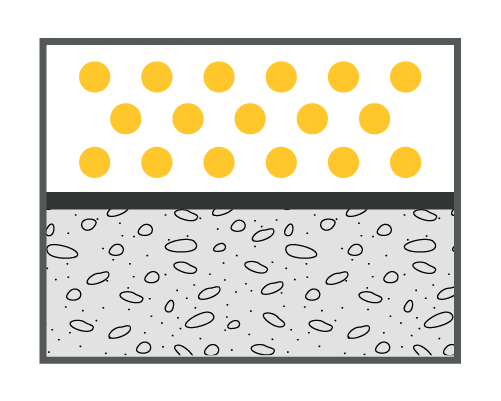
Separation
They prevent migration and mixing of coarse materials with fine materials.
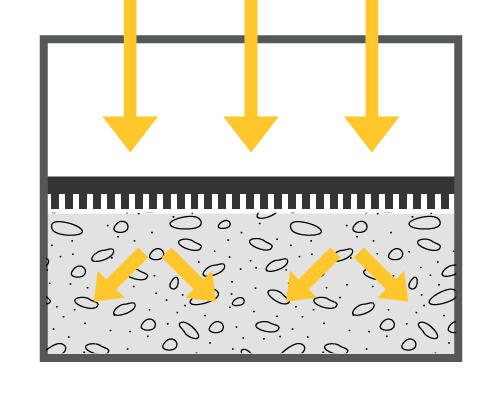
Reinforcement and Stabilization
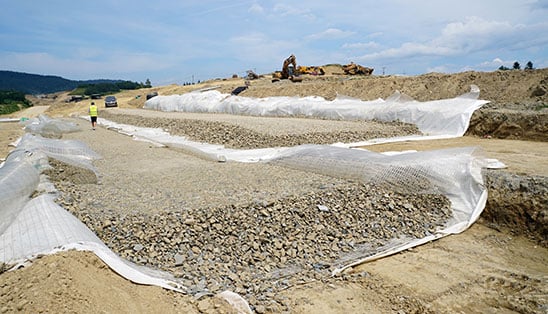
They add tensile stress to soft soils, thereby increasing their bearing capacity.
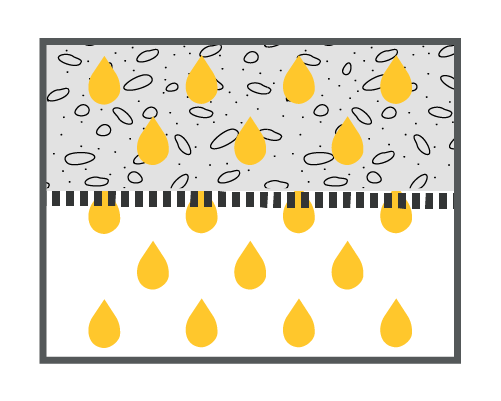
Filtration
They retain soil particles with diameters larger than their pores, allowing water to pass through.
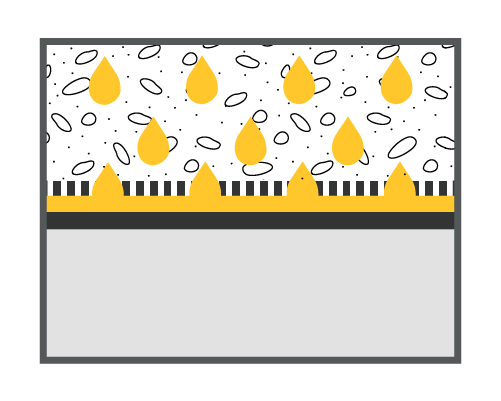
Drainage
They evacuate water and gases from the underlying soil through their plane, preventing damage from the pore pressure they generate.
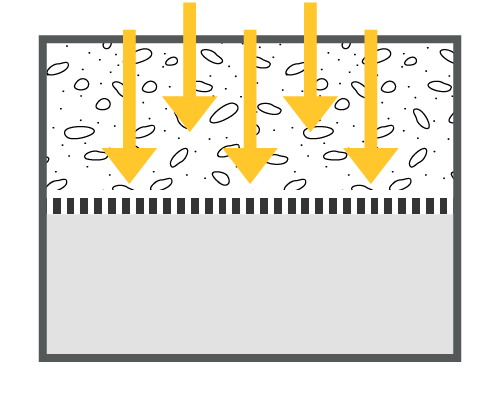
Protection
Buffers/avoids direct contact with a surface.
Geotextiles Applications
Secondary Containments
Landfills
Erosion Control
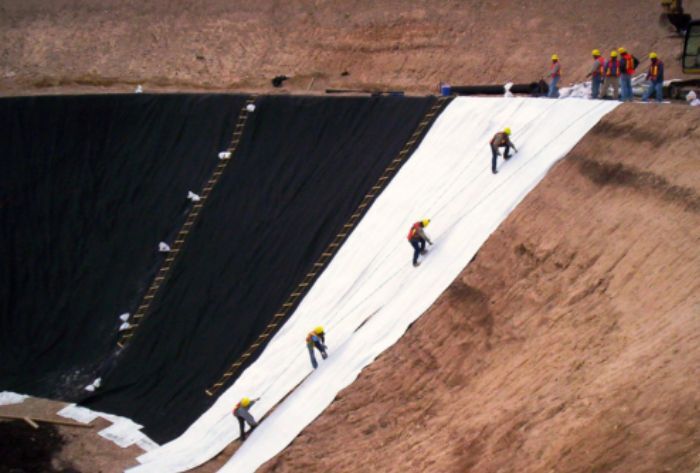
Heap Leach Pads
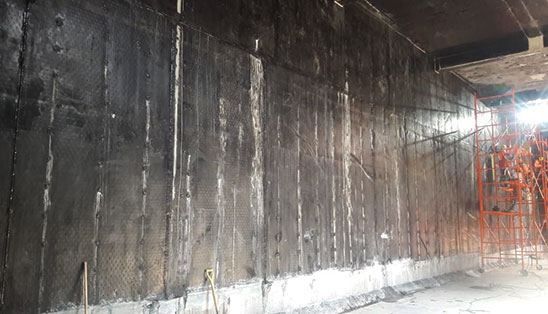
Tunnels
Retaining Walls
Foundations
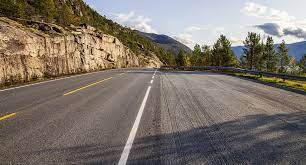
Roads
Do you have a project underway? Contact us.
We're the perfect ally to optimize your operation, guaranteeing efficiency and safety.